Enugu Graduate Chioma Was Rejected by Every AI Gig Platform — Until She Fixed One Invisible Mistake in 30 Minutes

You open your laptop before the day properly starts, because the data bundle is cheaper in the morning and because you still have hope at that hour.
You check your mail first. Nothing. Then the platform dashboard. Still “under review.” Still the same status as last week.
So you do the thing you always do. You find another platform. You fill another form. You upload the same CV you've now edited six times.
You take the assessment. You take it seriously. You read every instruction twice, you don't rush, you double-check your grammar, you submit before the timer runs out.
And then — silence. Or a message so polite it almost sounds kind. “We've decided to move forward with other applicants at this time.” No reason. No score. No hint of what went wrong.
What did I do wrong this time?
You can't answer that, because nobody tells you. That's the part that wears you down — not the rejection itself, but the not knowing. A failed exam at least comes with a mark. This comes with nothing.
So your brain fills the gap with the worst available explanation. Maybe your English isn't good enough. Maybe it's your location. Maybe they can tell you're new. Maybe you're just not smart enough for this kind of work.
Meanwhile someone in a group chat posts a screenshot of their acceptance mail, and you're happy for them, genuinely — and also quietly crushed, because you know for a fact you write better than them.
You stop telling people you applied. It's easier than explaining another rejection.
And you keep going anyway. More platforms. More assessments. More forms. Because applying more feels like doing something, even when it changes nothing.
I know that loop closely. I lived in it for months.
Here's what changed it for me.
My Real Story
I didn't start out trying to build anything. I started out just trying to get picked.
Like a lot of people reading this, I came into AI and remote gig work the ordinary way: a friend mentioned a platform, I looked it up, and the requirements didn't seem out of reach. Good written English. Attention to detail. Ability to follow instructions. I had all three. I applied with real confidence.
Then I got rejected. And I told myself that was normal — first attempt, no experience, fine.
So I applied to another one. And another. I passed some early steps, which made it worse in a way, because it meant I was almost there. Then the assessment stage would come, I'd submit something I was genuinely proud of, and it would disappear into silence.
After a while I stopped counting the applications. I only counted the days since the last reply.
What it actually cost me
The money part was real. Data isn't free. Time isn't free. Some of those assessments took two, three hours of careful, unpaid work — work that was genuinely good, and that nobody ever gave feedback on.
But the bigger cost was what it did to how I saw myself.
I started shrinking my own ambition to protect myself from disappointment.
I stopped applying to the platforms I actually wanted, because I assumed I'd fail those too. I started avoiding conversations about work. When people asked what I was doing, I gave vague answers. And every rejection quietly confirmed a story I'd started telling myself: maybe the problem is me.
Everything I tried that didn't work
I rewrote my CV. Repeatedly. New format, new wording, new bullet points, new order. My outcomes didn't move at all. That should have told me something earlier than it did — if the CV were the problem, changing it six times should have changed something.
I paid for a resume review. It came back cleaner, better formatted, more professional-looking. It was honestly a nicer document. It did not fix my rejection rate, because it was solving for how the document looked to a human recruiter, not for what these platforms were actually scanning and scoring.
I watched the YouTube videos. “How to get hired,” “top remote work tips,” “what recruiters want.” All general advice for general jobs. None of it spoke to how AI evaluation and gig platforms actually assess a submission — which is a different process entirely.
I asked a mentor. I got warmth and encouragement: “You're doing great, just keep trying.” Kind, well-meant, and completely useless as a diagnosis. Encouragement without diagnosis just keeps you doing the wrong thing with better morale.
I applied to more platforms. This was my main strategy for a long time. If the hit rate is low, increase the volume. But volume only works if the underlying approach is sound. Mine wasn't. I was just repeating the same invisible mistake at scale.
I tried to “be more confident.” Which is genuinely the most frustrating advice you can receive, because confidence isn't a strategy. Confident about what, exactly? I didn't even know what was being evaluated.
The question that actually changed things
The turning point wasn't dramatic. There was no chance meeting, no mentor who appeared at the right moment. It was me, sitting with my most recent rejection, tired enough to stop performing optimism.
And instead of asking my usual question — “what am I missing?” — which is really just self-doubt wearing a costume, I asked a different one:
“What are they actually scanning for, and where exactly does my application miss it?”
That's a completely different question. The first one has no answer; it's an invitation to feel bad. The second one has a findable, nameable answer. It turns a vague feeling of inadequacy into a specific mismatch you can point at.
And once I started looking for a specific mismatch, I found one. Not ten possible reasons. One. It had been in every single application I'd sent, in exactly the same place, for months.
What happened when I fixed it
The fix itself took under thirty minutes. That's not a marketing line — it's just what happens when the problem is finally named correctly. The hard part is never the fixing. The hard part is the diagnosis.
I revised one application the same day. Then another. And the pattern of my results changed — not into some fantasy where everyone says yes, but into something far more useful: replies. Movement. Progress I could actually learn from instead of silence I could only guess at.
Later, I started working professionally as an AI evaluator — which means I now spend my working days on the other side of the exact process that used to reject me. Assessing submissions. Seeing, up close and repeatedly, why one gets picked and a similar-looking one gets skipped.
That's when it stopped being a personal theory and became a pattern I could confirm. The thing I'd stumbled onto from the applicant's side turned out to be exactly what I could see from the evaluator's side, over and over, in other people's work.
Capable people were being skipped for reasons they would never have guessed — and would never be told.
Why I wrote it down
I kept meeting people in the same loop. Chioma, 25, from Enugu — a graduate doing remote content writing and data annotation, trying to build something stable out of gig work — is one of them. Qualified. Serious. Kept getting to the assessment stage and no further. Kept being told nothing.
She didn't need more encouragement. She needed a diagnosis. Within the first half hour of running the honest-questions worksheet on her most recent rejection — before touching a single new application — she had one clear sentence naming her actual blocker. She revised and sent her first application that same day.
When she called her mother back home, it wasn't to report another attempt. It was to say she'd landed the role. Her mother was stunned it happened that fast — and more surprised still to hear it wasn't luck. Chioma had simply found the one thing she'd been getting wrong the whole time.
I got tired of explaining the same thing in long voice notes. So I wrote it down properly, in order, with the worksheets and the exact wording included.
So I Put All of It Into One Short Guide
It isn't a course. It isn't 200 pages of theory. It's the shortest honest path from “I don't know why I keep getting rejected” to “I know exactly what's wrong and here's the fixed version.”
It's called “Why They Skipped You” — The One Overlooked Reason Your AI Gig Applications Aren't Converting, And the Fix That Takes 30 Minutes.
Everything in it comes from two places: months of personally applying and testing for these platforms and getting it wrong, and professional evaluation work assessing what separates a picked submission from a skipped one.
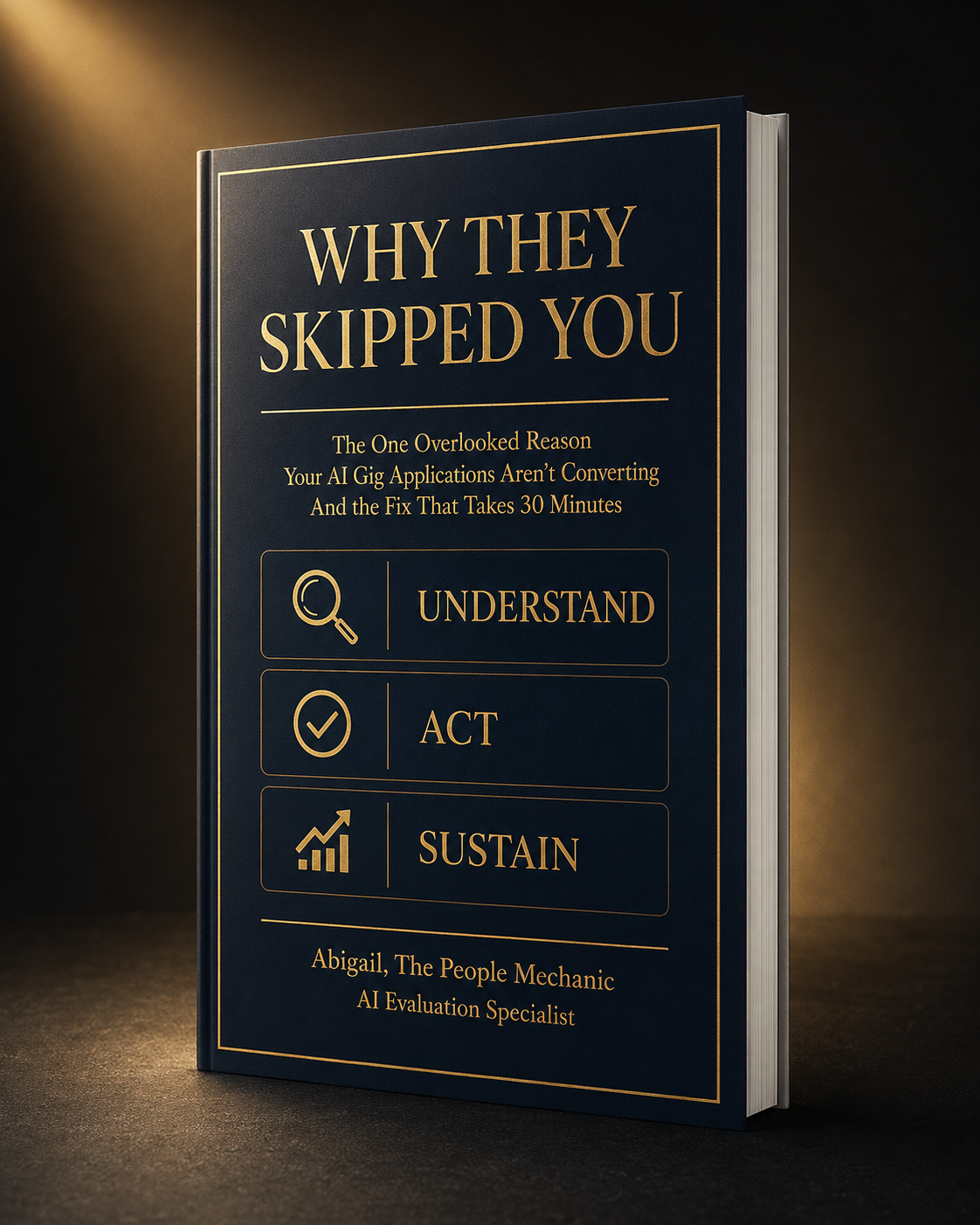
Inside this guide, you'll find:
- A few honest questions that show you exactly what's been going wrong — no more guessing at ten possible reasons. You end with one specific, nameable blocker. Pg. 3
- A simple way to see your application the way the evaluator sees it — so you know what's actually being looked at, and in what order. Pg. 8
- How to stop wasting time on platforms that were never going to pick you — and put your effort only into the ones that genuinely fit you. Pg. 13
- What to say to bring a dead application back to life — the exact wording. Copy, paste, send. Pg. 17
- One sentence you can add to any application that makes you the obvious pick — with the formula for writing your own version. Pg. 20
- A quick weekly check so you don't slide back into old habits — five minutes to catch yourself applying more instead of applying smarter. Pg. 23
What Readers Say
[INSERT REAL CUSTOMER QUOTE HERE]
[INSERT REAL CUSTOMER QUOTE HERE]
Note to you (delete before publishing): only two slots are here because you didn't supply verified testimonials. Send the guide free to 3–5 real readers, ask for honest feedback in their own words with name, city and permission to publish, then fill these in. Don't invent extras — in this niche, fake testimonials are the fastest way to lose the exact trust the page is built on.
What It Costs
Here's the honest value of what you're getting. Not a course you'll never finish — a diagnosis you can complete in one sitting, plus the exact wording to act on it: the self-questions worksheet, the evaluator's-eye checklist, the platform-fit filter, the revival message, the one-liner formula, and the weekly check-in.
Compare that to what most people spend instead: a paid resume review that makes the document prettier without changing the outcome, plus weeks of data and unpaid assessment hours poured into platforms that were never a fit.
Secure checkout on Selar · Instant download
Two Bonuses Included
These aren't padding. They're the two things people always asked me for right after reading the guide — a worked example, and wording they can adapt.
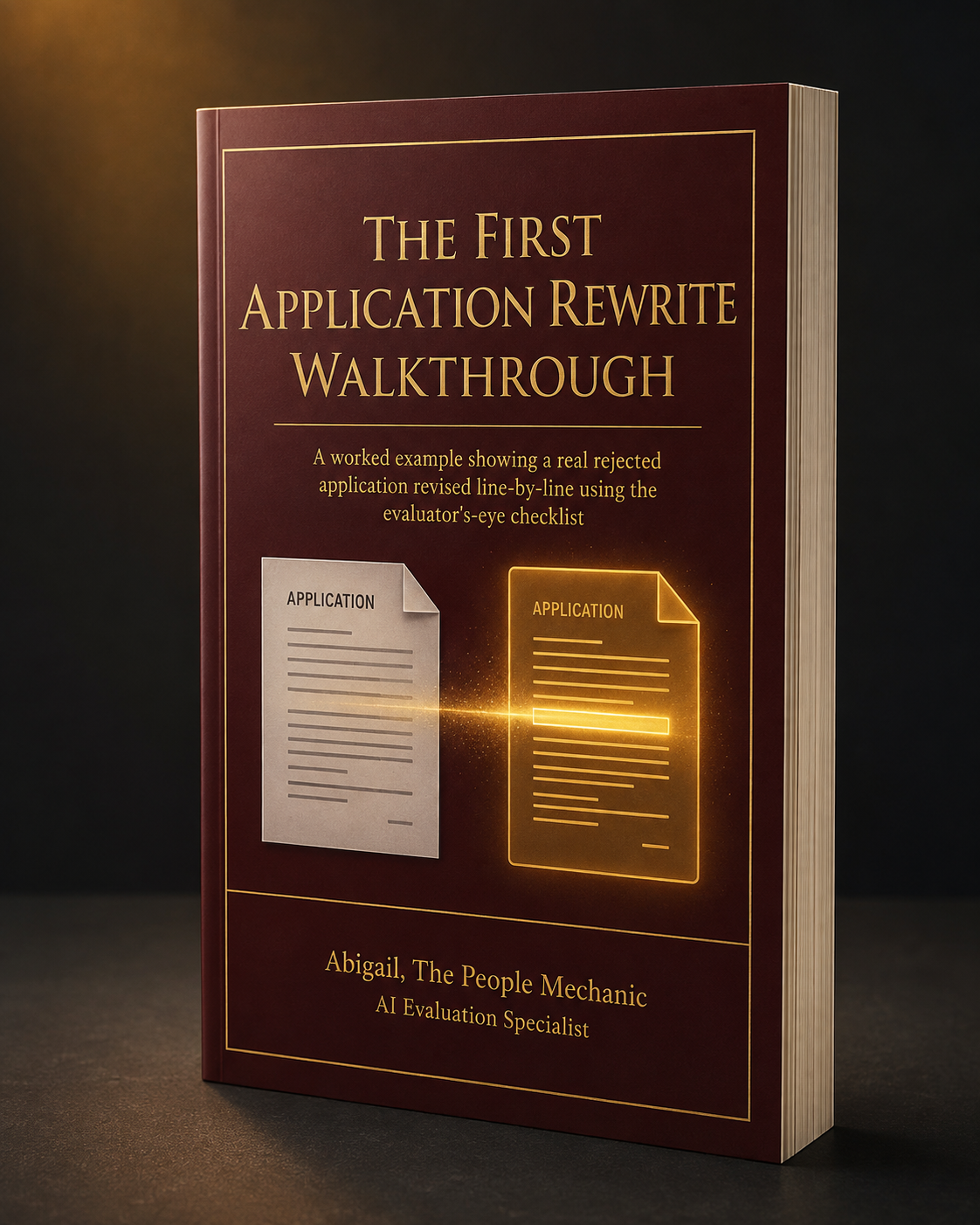
The “First Application Rewrite” Walkthrough
A real rejected application, revised line by line using the evaluator's-eye checklist — so you can see the change being made, not just read about it.
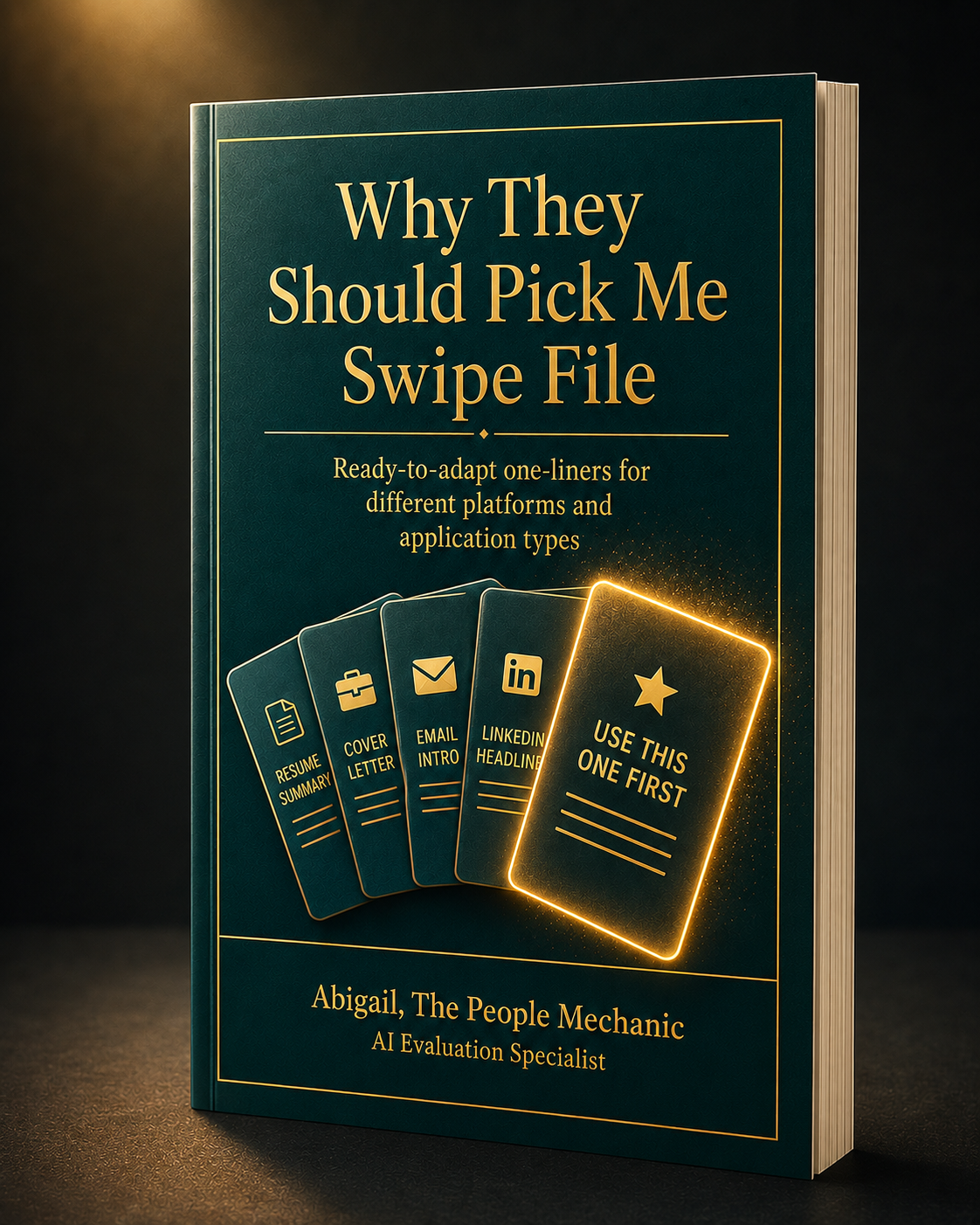
The “Why They Should Pick Me” Swipe File
Ready-to-adapt one-liners for different platforms and application types. Start from a line that works and make it yours, instead of staring at a blank box.
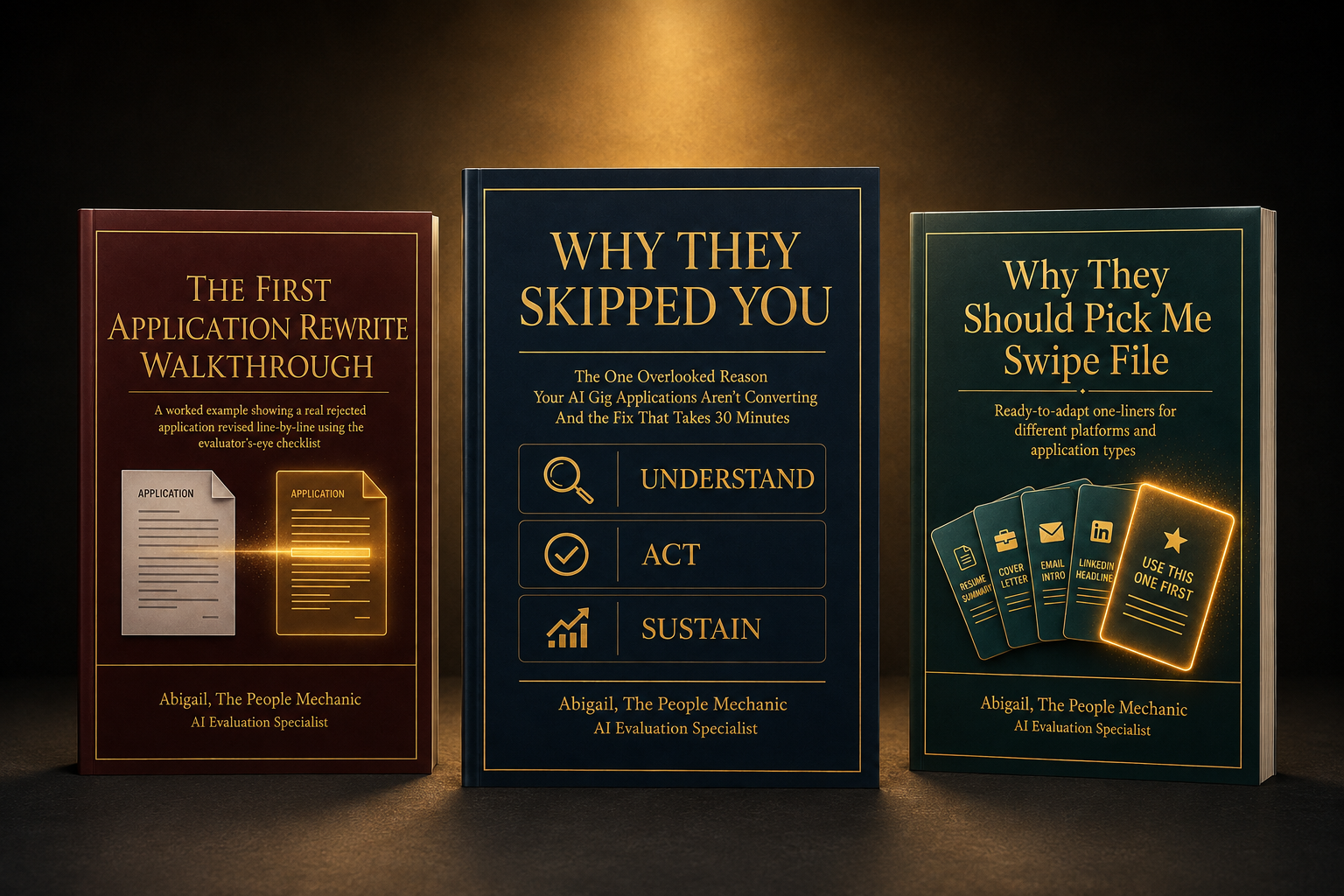
Both bonuses are included in the same download.
My 30-Minute Clarity Guarantee
Run the self-questions worksheet on your most recent rejection. If you don't walk away with one honest, specific sentence naming your real blocker, ask for a refund and you'll get it in full.
That's the whole promise. Clarity first — everything else in the guide only matters after you have it.
Refund available if the worksheet doesn't give you your blocker in one sentence.
One Last Thing
You don't need to become a different person to get picked. You're already capable — that was never the issue.
What's missing is information nobody hands you: what's actually being looked at, and where your application quietly misses it.
Thirty minutes from now you could have that in one plain sentence. Not a vague feeling. A specific, fixable thing you can point at — and then fix, today, on the application you're already sitting on.
That's the difference between applying more and applying smarter.
If you're ready to stop guessing, it's below. If you'd rather keep reading the blog first, that's genuinely fine too — I'll keep writing it either way.
Yes — Show Me Why They Skipped Me₦5,999 / $9 · Instant PDF + 2 bonuses · 30-minute clarity guarantee